Prehistoric stone tool technology
Long before written language, hominins and early humans began to make stone tools. Understanding the technological development of early stone tools reveals clues about the makers – their intelligence, what they were anatomically capable of and how they lived their lives.
At first, these tools were very simple, but over time, they became more refined and specialised, showing that hominins and early humans were learning, experimenting and improving their skills. It further shows the ability to communicate and learn the skills in order to build on them.

Biozone stone tool technology timeline
Stone tool technologies are the methods used to manufacture and shape stone tools. The four primary techniques are percussion (direct and indirect), blade making, grinding and polishing, and shattering.
This 3D interactive model allows student to examine different tools in 3D.
This 3D model is part of a collection by: BIOZONE International.
Stone tool technologies
There are four key methods for making stone tools:
Percussion – striking a stone with another rock or tool to chip off pieces and shape it.
Blade making – carefully removing long, thin flakes to create sharp-edged blades.
Abrading – grinding and polishing to smooth and sharpen a stone by rubbing it against rough surfaces. Sand, water or grit may be added to increase friction.
Shattering – breaking the rock into pieces to get usable fragments.

Morphological attributes of stone knapping
This diagram shows some of the morphological attributes archaeologists look for to determine if a stone has been made using a knapping technique.
Tools can be made from a combination of techniques. Knapping involves percussion and can include blade-making technologies. Knapping is fracturing a stone with another stone or hard material to chip off flakes to create a desired shape. A tool maker would first identify a rock that would break or fracture in a specific way. The desired fracturing attribute is called a conchoidal fracture. Some of the more common rocks that fracture in this way include obsidian, rhyolite, basalt, chalcedony and quartz. Knapped tools might also employ abrading to smooth or sharpen edges.
Key periods in stone tool development
Archaeologists use broad groupings to classify prehistoric periods and stone tool technology or industry. Archaeological periods are based on local material culture, technology and historical events (like ice ages) rather than a universal calendar, meaning changes occurred at different times in different regions. We have given average date ranges for the different stone tool technology periods.

Timeline of human evolution and stone tool technology
This timeline plots some of the stone tool technological industry periods against fossil finds of hominins and early modern humans.
Lomekwian industry (3.3 million years ago)
These are the earliest knapped tools yet discovered. The tools were large anvils, cores and flakes. This period pre-dates the appearance of early modern humans (Homo sapiens), and archaeologists have hypothesised that these were made by Australopithecus afarensis or Kenyanthropus platyops or another unknown hominin.

3.3 million-year-old tools pre-date Homo sapiens
Stone tools found at the Lomekwi site in Kenya have been dated to before the appearance of modern humans (Homo sapiens). They are the oldest knapped tools to be discovered. Experts have identified Australopithecus afarensis or Kenyanthropus platyops as the possible tool makers.
Oldowan industry (2.6 to 1.7 million years ago)
An early technology characterised by simple choppers and flakes made by striking one stone against another. Many hominin species were present across this period. The current thinking is that the tool makers were Homo habilis, Paranthropus boisei and Homo rudolfensis, but debate continues and other species cannot be ruled out. This is evidence that these earlier hominin species had the anatomy to grasp tools and the intelligence to make and use them.

Oldowan chopping tool
This basalt tool was excavated from Olduvai Gorge in Tanzania, Africa. The museum curator notes that “the cobble may have been used as a source of flakes for use in light duty tasks or as a chopping tool or both”.
From the Field Collection of Dr Louis S B Leakey
Acheulean industry (1.7 million to 200,000 years ago)
This period featured more refined tools like handaxes, which are bifacial tools (knapped on both sides of the stone) with sharpened edges. Many of these tools have been found with Homo erectus fossils. However, Homo neanderthalensis and Homo sapiens are also believed to have manufactured these tools. Researchers think areas with good stone for tool making were likely an important factor in the distribution of early humans.

Acheulian bifacial hand axe
A Lower Palaeolithic 500,000 to 40,000 BC hand axe knapped from dark grey flint.
Homo erectus is credited with first using this technology, which was later used by Neanderthals.
Mousterian industry (160,000 to 40,000 years ago)
In this period, the more sophisticated Levallois technique came into use. This knapping method involved a prepared core, which was struck in a specific sequence to produce predictable flakes. There are earlier recorded uses, but the technique is predominantly associated with this period and Neanderthals in Europe. Mousterian-style tools in North Africa and the Near East are associated with Homo sapiens.

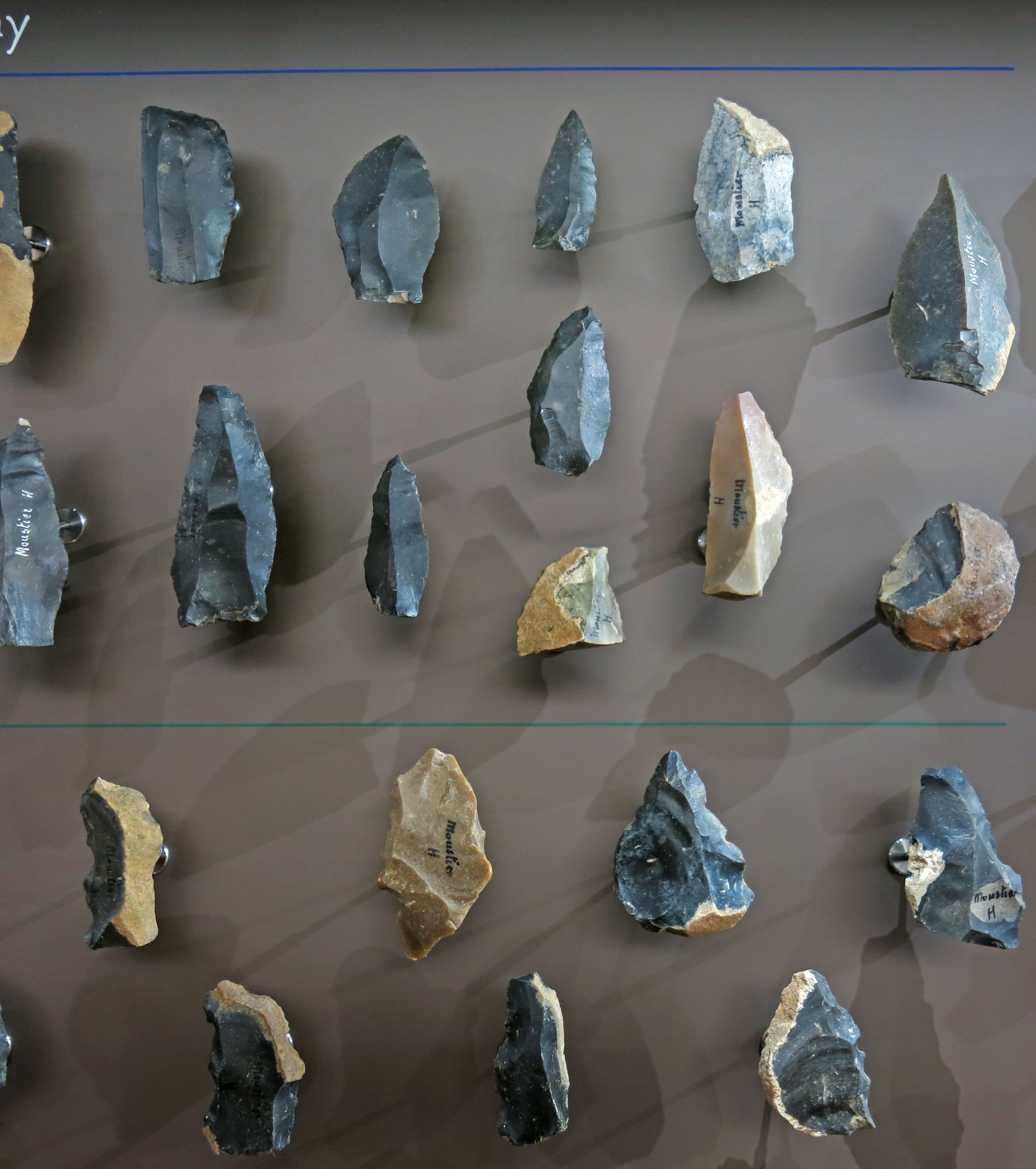
Mousterian ‘toothed’ tools
Denticulate (toothed) tools appeared in the Mousterian. They were produced by making notches in a flake. It is thought they may have been used like saws.
These tools were excavated from Le Moustier in France and were made by Neanderthals.
The tools of this period became more specialised and they also show signs of being retouched. Retouching refers to repeatedly sharpening or flakes that have been shaped to make handling safer.
This industry has a lot of flaked tools, scrapers and blades, spear points and denticulate (toothed) instruments.
Aurignacian industry (43,000 to 22,000 years ago)
This technology is associated with early modern humans in Europe. Instead of just chipping flakes off rocks, tool makers began shaping long, thin blades. They also invented chisel-like tools called burins (used for carving) and began using materials like bone and antler. Art and decorative items became more sophisticated in this period. For example, the mammoth ivory carving Venus of Brassempouy, dated to this period, is one of the earliest realistic human face representations. Evidence of needles tooled from bone and ivory suggests this is when humans began to sew clothing and other goods.

Multiple views of an Aurignacian burin
This flint burin dated to 29,000 to 22,000 years ago was found at Brassempouy in France.
The sophisticated mammoth ivory carving Venus of Brassempouy is a likely made with burin tools.
Microlithic industries (10,000 to 5,000 years ago)
This time period is in the Mesolithic, just after the late Palaeolithic period. A key technical development in this period was the creation of microliths. Microliths are small, finely-made stone flakes such as arrowheads. Composite tools for engraving were also formed – an example is a tool that might have a stone top and a wooden handle.

Rönneholm arrow with microlith barbs
This artefact was recovered in a peat bog in Sweden. It consisted of pieces of wood and microliths, some attached by resin to the pieces of wood.
The arrow shaft was made of a 1-year-old branch of hazel. A V-shaped groove had been cut into the wood, and four microliths had been fixed into the groove with resin to form barbs.
Carbon dating on the wood and resin suggest the arrow is 8,500 to 9,000 years old. Archaeologists believe the arrow is from the Maglemose culture, a Mesolithic hunter-gatherer culture.
The rare completeness of the artefact provides evidence of how people of the time constructed weapons and hunting tools. Learn more about this artefact in this article.
Ongoing stone tool development
Stone tool technology continued to develop in the Neolithic era (New Stone Age). More ground tools began to appear. These tools were made by grinding or rubbing and included tools for crafts, farming and food processing. The Neolithic era was followed by the Bronze Age, when metal technologies emerged. This was also the time when humans moved from hunting and gathering to built-up settlements and farming.
Stone tool making is a historic tradition that has been retained by many cultures beyond the Palaeolithic period. Stone tools dating back to 1300AD have been found in New Zealand. Early Māori made tools and decorative items from basalt or other hard rock like adzite (a metamorphic rock) and sedimentary rocks like chert or greywacke and pounamu.
Some carvers in Aotearoa continue this tool-making tradition for their whakairo today.
Related content
Discover more about Palaeolithic stone tools and what they were used for.
Take a closer look at human evolution in Becoming human – hominins.
Evolutionary research – advancing our understanding of us and Palaeogenomics and human evolution unpack some of the growing technologies scientists and archaeologists are using to better understand human evolution.
Obsidian is a volcanic rock. Watch this video to learn about volcanic rock types in New Zealand.
Fossil correlation is an activity to help students understand how the age of fossils in one rock can be obtained using dates from fossils in a different place and that most fossil artefacts (and also stone tools) can only be dated to a time range, not a precise date.
Dating the past is a suite of resources that look at the geologic timescale and how geologists date fossils and rock.
Lapita cultural complex looks at how archaeologists and other experts use material culture – like pottery – to better understand our ancestors. The activity Exploring Lapita pottery through observation and art is a cross-curricular activity that uses Lapita pottery as the context for enhancing scientific observation by recreating old artefact designs.
Useful links
Read more about the Lomekwian industry – the oldest known stone tools unearthed in Kenya – and how experts have sought to identify the human ancestors that made them.
African Fossils has an image gallery of ancient stone tools that can be manipulated and viewed in 3D.
This resource on the Levallois technique has a useful 3D animation of the process that was used in the Mousterian industry.
Research shows that Homo neanderthalensis used birch tar and other compounds to make an adhesive. Read more in Neanderthal ‘glue’ points to complex thinking.
Cherokee Noel Grayson explains the ancient tradition of making stone tools and arrowheads in this video on flint knapping.
Learn about some of the different stone types that were used for used with the knapping technique.
Explore how early Māori used stone: Kōhatu – Māori use of stone.